
Introduction
Among my organisational development projects, there’s one story I always like to share. During an initial meeting, a leader proudly explained how their company had grown – now eighty people strong – how they had introduced modern tools and methods, and how, overall, everything seemed to be going well. “We’ve invited you because it’s time to create our organisational culture,” he concluded. Unfortunately, I had to give him the bad news: the culture had already created itself.
This is often the point when a question arises: “Why isn’t digitalisation working, when we already have all the tools for it?”
In today’s fast-paced world, organisations often embark on digital transformation to better meet market challenges, hoping that new technologies will help them respond more effectively to changing demands. But sooner or later, they face the realisation that digitalisation is much more than introducing new tools or methodologies that exist as buzzwords without depth or substance. Within any organisation, the use of tools and methods depends on the understanding, willingness, and motivation of the people applying them – in other words, on how things get done. This set of underlying behaviours and attitudes is what we call organisational culture. Yet culture is not easily changed. Introducing a new system won’t automatically alter how results are achieved. As Peter Drucker famously said, “Culture eats strategy for breakfast.” Shaping culture is one of the greatest leadership challenges: instead of moving the organisation towards unity, it often drives a wedge between teams, functions, or even generations.
What’s certain is that the leader’s attitude plays a crucial role in shaping that culture. If the leader is the one lagging behind in technology use, their credibility may be questioned, and team morale may suffer as a result.
But how can we know who is truly capable of leading change? Fortunately, there is now a tool that helps us answer that question – the Game Changer Index® (GCI) – which focuses on the impact leaders have on their environment. This article explores how digitalisation shapes organisational culture in both SMEs and multinational companies, and how the GCI can support this process.
Digitalisation and Organisational Culture: Ready for Change!
Digitalisation often arrives with rapid innovation and new technologies. Yet, for any organisation, the real challenge lies in developing a digital culture. International research (for example, MDPI and Springer) confirms that sustainable competitive advantage stems from the combination of digital strategy and digital culture – particularly for SMEs, where digitalisation can be a major growth driver. According to these studies, for a company’s digital strategy to succeed, technology and organisational culture must work in sync; otherwise, the new tools simply become shelf ornaments. However, transformation often fails to achieve its intended impact. Surveys show that while nearly 80% of leaders consider their digital transformation successful, only around 57% of employees agree.
Employees’ digital fluency requires deliberate development:
- Guidance – through leadership role modelling and skill-building;
- Empowerment – allowing people to shape their own work processes related to digital tools;
- Support – providing psychological safety to experiment and fail safely (“safe to fail” environments).
These factors together create the psychological safety necessary for courage and confidence during change.
Why Doesn’t It Work for Everyone?
The challenge of digitalisation rarely lies in the lack of tools (or even methods), but in the attitudes of employees and leaders. A multinational company may advance more quickly thanks to greater resources and expertise – yet if its leaders fail to adapt, innovation remains superficial. Hungarian SMEs face similar issues: while many invest in modern technologies, their organisational culture often fails to evolve accordingly. What’s needed is a digital culture that allows innovation to appear not just on a technological level, but in everyday operations.
According to MIT and Capgemini, a digital-first culture is built on:
- customer centricity,
- innovation,
- data-driven decision-making,
- strong collaboration,
- flexibility and agility where digital solutions are front and centre.
When we look at the reality of Hungarian SMEs, however, we see a rather different picture. And the greater the distance between the current reality and the desired future, the harder the transformation becomes.
The Leader–Employee Relationship in the Era of Digitalisation
Digitalisation profoundly affects leader–employee relationships, especially across generations. Older employees often feel uncomfortable in a constantly changing technological environment, while younger ones use it with ease. If a leader falls behind technologically, the team may quickly question their credibility – and wonder whether they can keep up with competitors who are further ahead in their digital journey.
Thus, digitalisation requires leaders to continuously develop their technological competencies and stay open to new methods, especially when their younger team members already embrace them naturally. This is increasingly vital, as digitalisation is not just a technical upgrade – it is a cultural transformation that shapes everyday work and motivation.
Game Changer Index® – A New Standard!
Change happens where attention is focused – and we only notice it when it can be measured. Traditional ways of measuring leadership effectiveness have largely focused on personality traits or competencies. Yet neither has truly captured organisational culture or the impact leaders have on it. The Game Changer Index® (GCI) introduces a new dimension: it measures the preferred impact leaders make on their environment.
The GCI is an innovative yet reliable tool that is not psychometric (personality-based) but organometric – meaning it focuses on how individuals operate within their organisation. This perspective is particularly relevant in an era of constant change and digital acceleration.
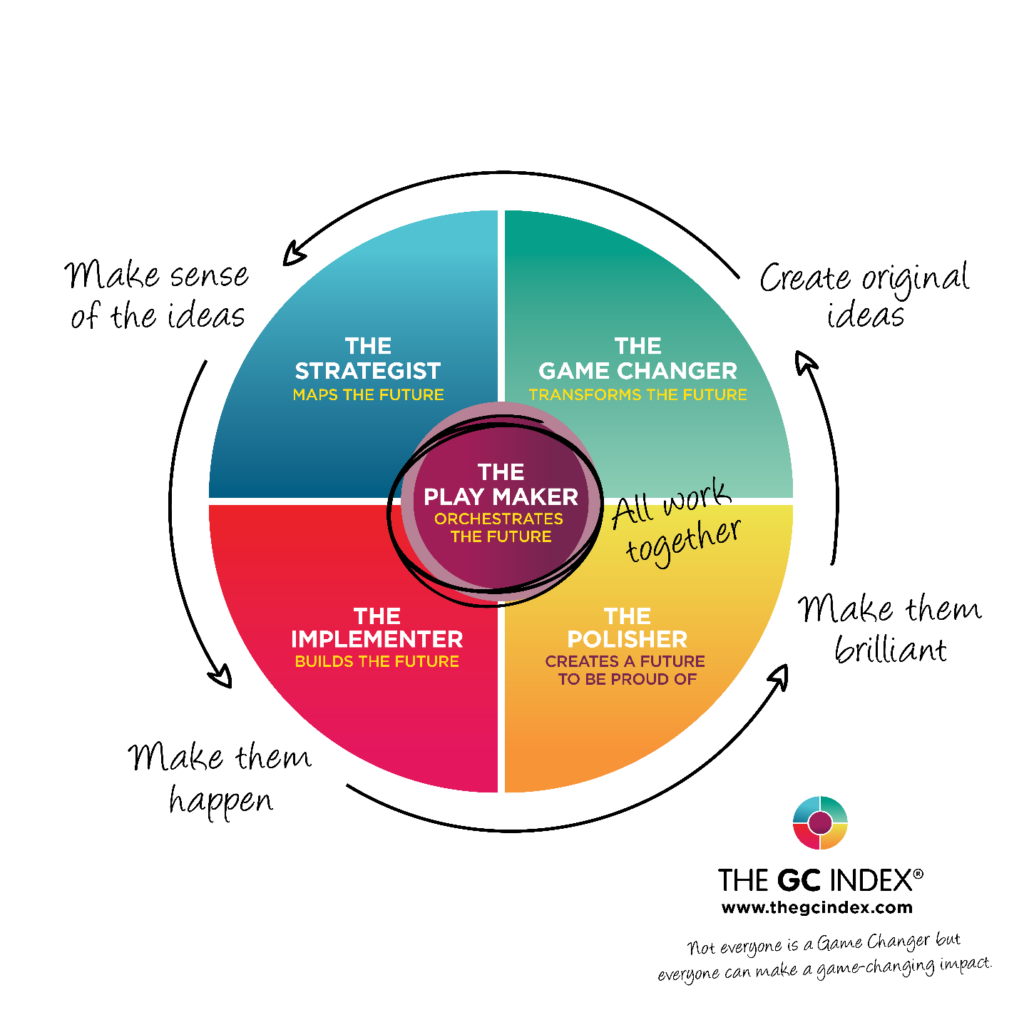
The GCI identifies those capable of acting as Game Changers – people who bring new ideas to life and take the lead in driving them forward. Through the GCI, leaders can objectively assess how they can best support digital innovation, how credible they are in applying new technologies, and who they can rely on during transformation. This becomes especially important when digitalisation coincides with generational transition within an organisation.
Why the GCI?
The GCI proves particularly valuable when turbulence arises during digital transformation. Beyond understanding their own individual impact, leaders can use it to evaluate the collective impact of their leadership team – allowing data-driven decisions about whose impact energy to leverage at each stage of a project. The GCI’s framework mirrors how business processes actually operate, making its insights immediately transferable into organisational practice. Even the measurement process itself fulfils one of the core expectations of digitalisation: data-driven decision-making. By using the GCI, leaders can shape the digital future more consciously and support transformation at every level of the organisation.
Generational Shift: Turbulence and Challenges
Managing digitalisation and generational change simultaneously is no easy task.
The complexity increases as senior leaders hand over responsibility to younger successors. Older generations tend to value stability and proven methods, while younger ones gravitate towards innovation and experimentation. International research highlights that establishing a successful digital culture requires organisational-level commitment, supported by leadership impact measurement – such as that provided by the GCI.
The Leadership Skills of the Future: What’s Next?
With the rise of digitalisation, new leadership skills are becoming essential – such as data-driven decision-making, adaptability, and agility. A modern leader stands out not only through technical knowledge, but through the ability to understand and adapt to digital change – and to lead others through it. The era of superheroes is over. Success now belongs to those who can turn their colleagues into allies, combining their strengths at the right time to achieve shared success. The leadership of the future represents an entirely new approach.
Raise the Stakes for the Digital Future!
The digital future is not only about technology – it’s also about cultural transformation, deeply tied to leadership impact. The Game Changer Index® offers leaders the opportunity to guide digital transformation more consciously and to shape the evolution of organisational culture. For companies, it’s essential that digitalisation means more than just acquiring tools. It must represent a true cultural shift – the very key to achieving tomorrow’s competitive advantage.